
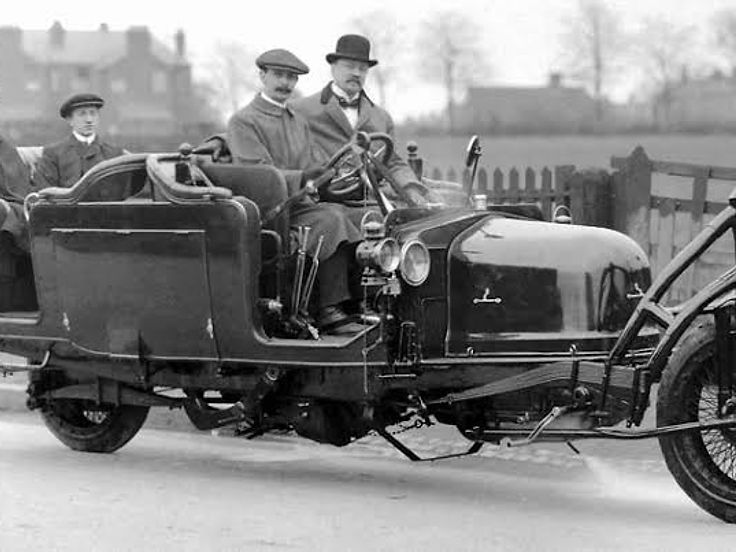
Londoners witnessed an unusual demonstration in Regent's Park during May 1914. A large passenger car drove around with six people aboard, but it had only two wheels, positioned one behind the other. The machine belonged to Russian inventor Pyotr Schilovski, who had commissioned British manufacturer Wolseley to construct an automobile that could balance itself using a gyroscope. Schilovski believed a narrow, two-wheeled vehicle could use less road space and potentially operate more efficiently than a conventional car. The challenge was making something weighing several tons stand upright without relying on the driver to balance it like a motorcycle.
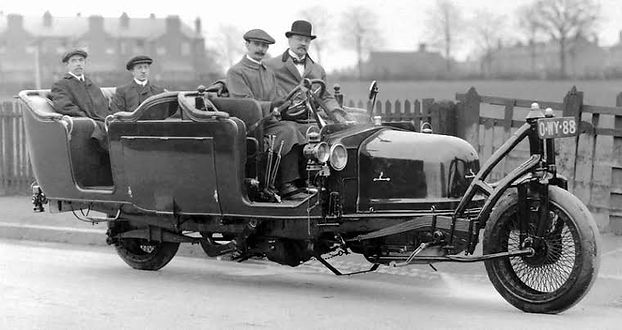
A large gyroscope was installed beneath the passenger compartment, with an electric motor spinning the assembly at approximately 1,100 rpm. Through a system of pivots and controls, the gyroscope resisted sideways movement and helped stabilize the car as it traveled. The vehicle itself was substantial, reportedly weighing around 2.75 tons, with a conventional gasoline engine driving the rear wheel. Its passengers sat in an enclosed touring-car body that looked relatively ordinary apart from the narrow wheel arrangement. That contrast made the demonstration particularly striking: from the side, it resembled a traditional Edwardian automobile, but from the front, it appeared far too narrow to remain standing.
The Gyrocar attracted considerable interest from engineers and the British press, although its complexity ultimately worked against it. A conventional four-wheeled chassis achieved stability without requiring a continuously operating mechanical balancing system, and Schilovski's design added considerable weight to solve a problem most motorists never had. The project ended without production, and the original machine was eventually lost. Still, the experiment was more than an eccentric spectacle. It demonstrated an early form of active vehicle stabilization, an idea that engineers would continue exploring throughout the twentieth century and beyond.


