
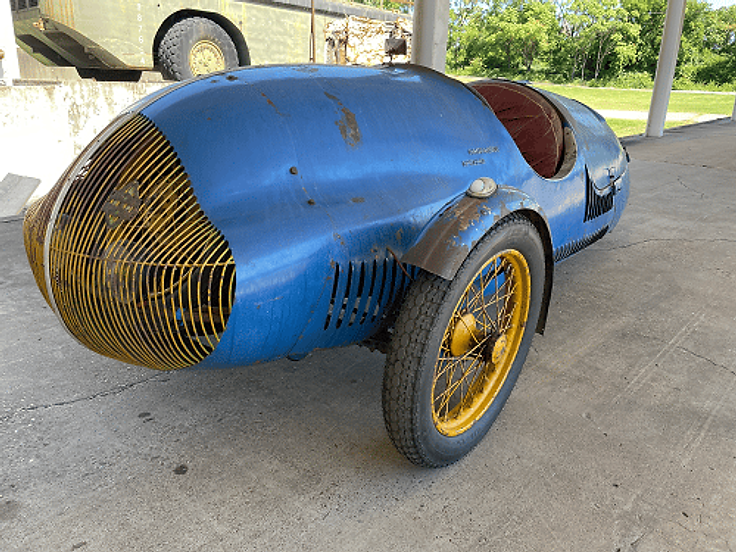
Automobile production in France was recovering slowly after World War II. New cars were expensive, materials were scarce, and many motorists had little choice but to keep old vehicles running or build something themselves.
Pierre Castarede took the second approach.
In 1948, he assembled a three-wheeled automobile using the mechanical components of a 1938 Gnome et Rhône motorcycle and parts salvaged from an Amilcar. The resulting machine was not a manufacturer's prototype or an attempt to establish a new automotive brand. It was a personal solution to the shortage of practical transportation.

The Castarede retained a distinctly motorcycle-derived powertrain. Its engine was an air-cooled, horizontally opposed two-cylinder four-stroke displacing 800cc and developing approximately 18.5 horsepower.
The engine sat behind the passenger compartment in a rear-mid-mounted arrangement, sending power to the rear wheel through a four-speed manual transmission.


One notable limitation was the absence of reverse gear. Moving backward required the driver to physically maneuver the vehicle, an inconvenience that would have been familiar to owners of some early cyclecars and motorcycle-based specials.
The bodywork gave Castarede's creation a more finished appearance than many improvised postwar vehicles. Its low proportions, enclosed mechanical components, and compact three-wheel arrangement made it resemble a small sports car rather than a motorcycle conversion.


The mechanical configuration offered some advantages. By placing the engine behind the seats, Castarede avoided the packaging challenges of mounting the motorcycle powerplant ahead of the occupants. The relatively powerful opposed-twin engine also provided enough output to make the lightweight vehicle a plausible means of transportation.


Only one Castarede was constructed.
Remarkably, the car survives in unrestored condition at the Lane Motor Museum in Nashville, Tennessee. Its originality is particularly valuable because it preserves the solutions, materials, and workmanship of its individual builder.
The Castarede is an example of automotive history created outside a factory, when necessity and mechanical ingenuity could produce an entirely new automobile from parts that already existed.


