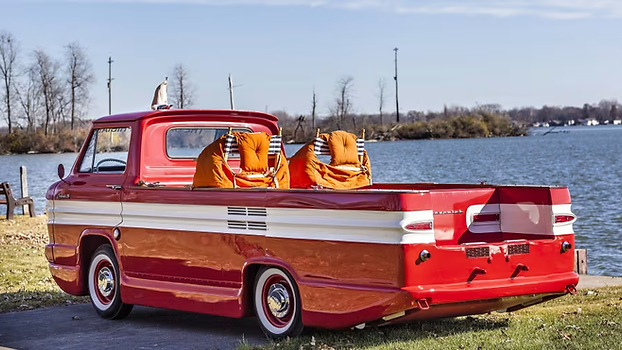
In 1961, two General Motors engineers developed an amphibious Chevrolet Corvair pickup that could travel on land and operate as a small boat.
The project was called the Corphibian, and it was based on the Chevrolet Corvair 95 Loadside pickup rather than a purpose-built marine vehicle.
Richard E. Hulten and Roger D. Holm, engineers associated with Pontiac, established their own company, Hulten-Holm Co., to develop the prototype outside Chevrolet's official vehicle program.
Their starting point was an unusual truck in its own right. Unlike conventional American pickups, the Corvair Loadside used a rear-mounted, air-cooled flat-six engine and a compact forward-control body.

The engineers retained the Corvair's basic drivetrain but added a fiberglass boat hull beneath the vehicle. The cargo bed was extended, helping accommodate the additional marine equipment.
For travel on water, a pair of rear-mounted propellers provided propulsion. The engine supplied power for both ordinary road driving and marine operation.
The vehicle retained its automatic transmission and was fitted with additional controls for water use. Much of the marine control equipment was positioned in the cargo bed, allowing operation from the rear of the vehicle.
The Corphibian used an air-cooled six-cylinder engine rated at approximately 84 horsepower. This was particularly suitable for the conversion because the engine did not depend on a conventional water-cooled radiator positioned in the front of the vehicle.
The prototype was tested on a Michigan lake in 1961, demonstrating that the conversion could operate on water as well as on the road.
Hulten and Holm hoped Chevrolet would recognize the vehicle's commercial potential and purchase the design for production. General Motors ultimately declined.
Only one Corphibian was built, while the German Amphicar entered series production during the same period.
After spending years in storage, the Corphibian was preserved and returned to its red-and-white appearance. It is now part of the Lane Motor Museum collection in Nashville, Tennessee.
It remains one of the strangest Corvair derivatives ever constructed, combining Chevrolet's already unconventional rear-engine pickup with an entirely different mode of transportation.