

Swedish inventor Sigvard Berggren believed he could build the automobile of the future using the remains of a retired taxi. The result was a long, streamlined machine with an aircraft-like body, an enormous dorsal fin, and a Ford V8 mounted behind its passenger compartment.
Berggren began work on the project in 1951, using the chassis of a 1938 Dodge seven-passenger sedan that had previously served as a taxi. Rather than simply fitting a custom body to the existing mechanical arrangement, he extensively reworked the vehicle around a mid-rear-mounted engine.



The powerplant was a Ford flathead V8 displacing 239 cubic inches, or approximately 3.9 liters. It produced around 100 horsepower and was coupled to a four-speed manual transmission.
The body was inspired by aircraft construction. Berggren and his collaborators fabricated a framework of tubular steel before covering it with hand-formed metal panels. The resulting shape was closer to an airplane fuselage than a conventional passenger car.
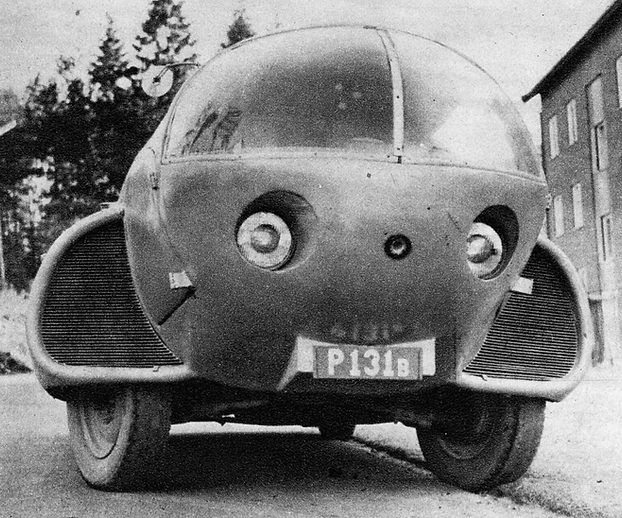
A long, tapered nose extended ahead of the cabin, with the passenger compartment positioned well back in the body. Behind it, the roofline descended toward a tail dominated by a vertical stabilizer-like fin.


Even the headlights and cooling openings were incorporated into the aircraft-inspired styling, creating an appearance that seemed appropriate for a futuristic illustration.
For all its aerodynamic ambition, the Future was not particularly light. The combination of a large Dodge chassis, substantial steel structure, and elaborate bodywork imposed a weight penalty that limited its performance.
The car was completed in time for a newspaper deadline and received significant attention in Sweden during the early 1950s. Berggren had built something visually extraordinary, even if its mechanical performance fell short of the appearance.
His later life took an entirely different direction. After becoming interested in wildlife conservation, Berggren established a zoo and pursued environmental projects in Africa.
The Future remained a one-off. Now preserved by the Lane Motor Museum, it is a fascinating record of an era when streamlining, aircraft technology, and the promise of faster road transport inspired independent inventors to build their own visions of tomorrow.


